Once upon a time... cocoa or the gold of the Mayans

"The first time ships appeared on the coast of "New Spain", the captains of the Aztec emperor Moctezuma went to see what was going on. At the sight of the Spaniards, all kissed the prows of the ships in adoration: they thought it was the god Quetzalcoatl who was returning."
This is what the missionary Bernardino de Sahagún (1500-1590) wrote in his encyclopedia dedicated to the Aztec world, written half a century after the events.
Quetzalcoatl, but what is it? The most powerful God in the Mayan pantheon! By what miracle could the navigator Hernan Cortes have been confused with the Feathered Serpent God?
The answer lies in a prophecy: Quetzalcoatl, who had disappeared for centuries, had promised to return to his people in the form of a bearded, light-skinned man, during a "reed" year of the Aztec calendar. As luck would have it, the year 1519, the year Cortes arrived, was just such a year!
And then Quetzalcoatl is a polymorphic god. This surely explains that, because venerated probably since the Olmec civilization (1200-500 BC) by the populations of central Mexico, as well as by the Mayans, Quetzalcoatl has, in fact, taken on a multitude of aspects. In ancient times, in the form of a serpent, he was also one of the agricultural gods, guarantor of the fertility of the earth - Other peoples venerated him in the form of the planet Venus, the natural compass of itinerant peoples. For still other peoples, he embodied the wind. For all, he was part of "The Legend of the 5 Suns", at the origin of the birth of the earth and of men.
Moreover, another visitor, this time from the African continent, was also mistaken for the Feathered Serpent: Abubakari II, Mansa (king) of the Mandingo empire in the 14th century, descendant and successor of Soundjata Keita, who came from the other side of the ocean, 200 years before Christopher Columbus! The legend on that side speaks of a man dressed in white... It seems that our African boubous were already majestic and sparkling in the sun.
All things considered, this misunderstanding was very convenient for our Spanish invaders: to be taken for the God creator of the earth and of the human species! Especially since they came in search of riches, and were offered gold. There was some everywhere.
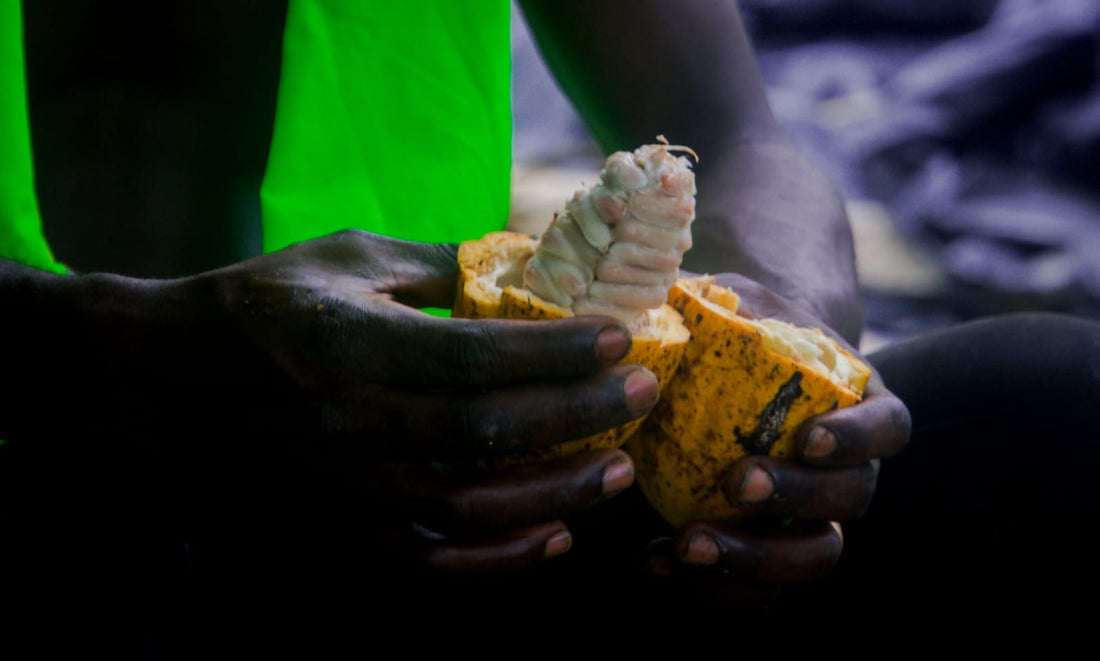
But what they also received from Mesoamerican populations such as the Mayans and Aztecs was their most precious possession: small brown beans that they called "kakaw" or "cacahuatl", which they used in their rituals and diet. However, the Spanish did not perceive their true value until much later.
It was the son of Christopher Columbus, who came well before Cortes, who recorded in his memoirs a very strange excitement around these small brown seeds that seemed to provoke an unusual veneration among the natives. However, these beans had a bitter taste and were very little appreciated at the time of the first contact.
The natives used it for everything! Drinking, eating, praying or worshipping the Gods... but also as a currency. A very codified currency where a donkey was worth more than a woman!
This bean is precisely what the serpent god would have offered them so that they would take care of it,
The story goes that the conquistadors found an astronomical number of them!
And for good reason: the real treasure of the Mayans was the cocoa bean!
Today, the whole world is watching over this treasure!
And for good reason: without cocoa, no chocolate!
---------
*Wikipedia
**they were there before Christopher Columbus" Ivan Van Sertima. The Afro-Guyanese historian wrote about the testimony of Emperor Kanku Moussa recorded by the Arab Ibn Amir Hajib and transcribed by Al Omari in the 14th century in Egypt during Moussa's pilgrimage.